
Transparency Hub is a user-friendly platform that aggregates and archives the policy documents (and associated data) that social media companies release. The platform is focused on increasing visibility into how data flows through the social media ecosystem. It is accessible on GitHub here.
Vision
To facilitate platform transparency and public-interest research by offering researchers and the general public an accessible interface to explore the policies and public-facing documents released by social media companies.
Goals
The project aims to
- Aggregate and archive public-facing social media company documents like privacy policies, terms of service, transparency reports, and community guidelines in real time, all in one place
- Provide tooling that lets people—whether they are researchers, teachers, or parents—easily search, analyze, export, and compare documents.
Why This Matters
Social media platforms have enormous influence over public life. Unfortunately, their policy documents are often difficult to find, hidden behind hard-to-locate URLs. The documents also lack a standard cross-company format, use verbose and confusing language, and rarely include a version history. These shortcomings make it difficult to track how platform governance changes over time, over companies, across jurisdictions, and in response to external pressure. The Transparency Hub system facilitates transparency research by making policy documents easier to find, analyze, and compare.
How It Works
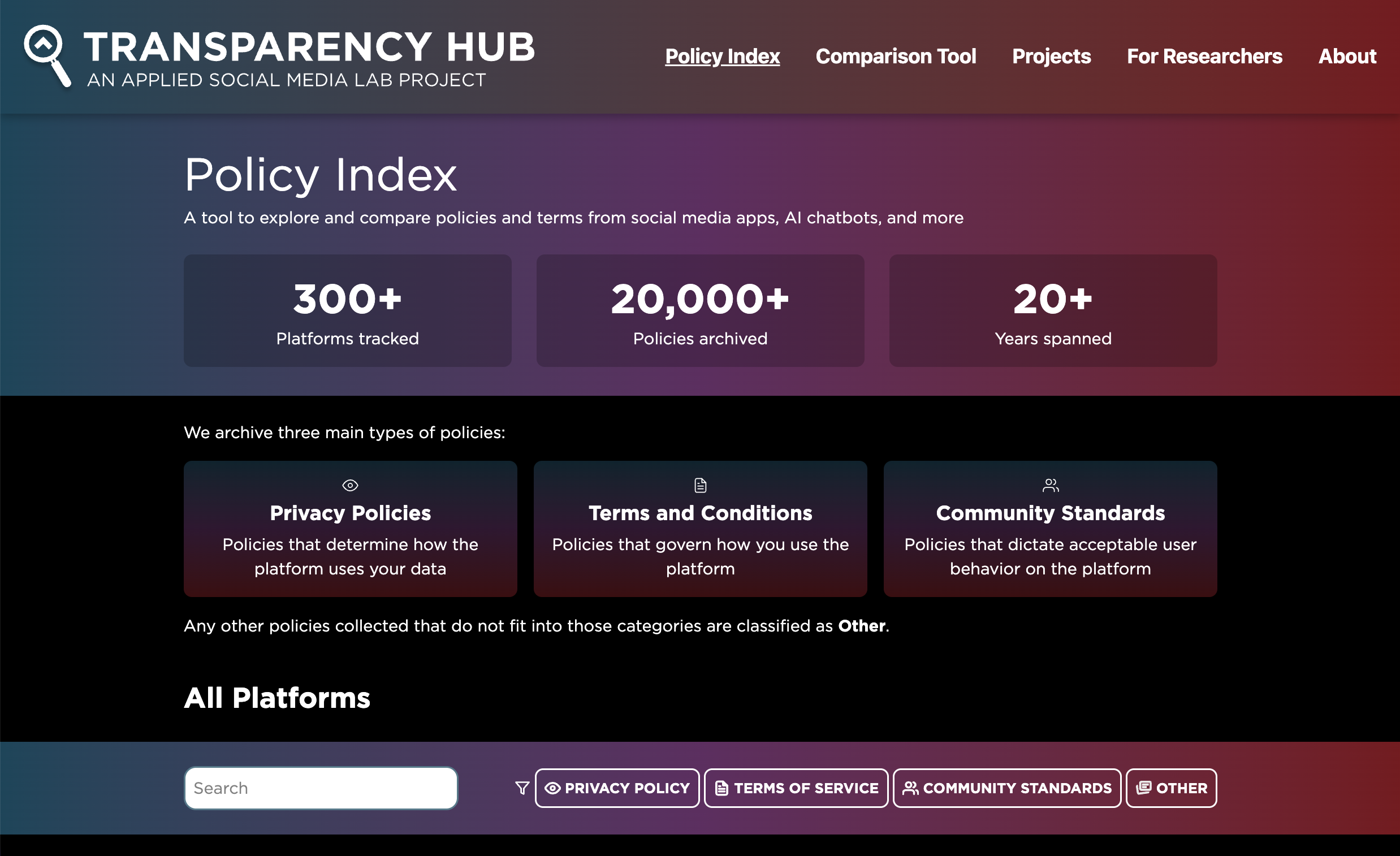
The Transparency Hub system consists of a user-facing website that, behind the scenes, talks to a database which stores the hundreds of policy documents that we have downloaded.
Data collection: We have automated mechanisms for detecting and downloading updated policy documents from over 300 social media companies. This eliminates the tedious task of gathering these documents and helps researchers evaluate both how these policies have changed over time and how they are impacting users like you right now.
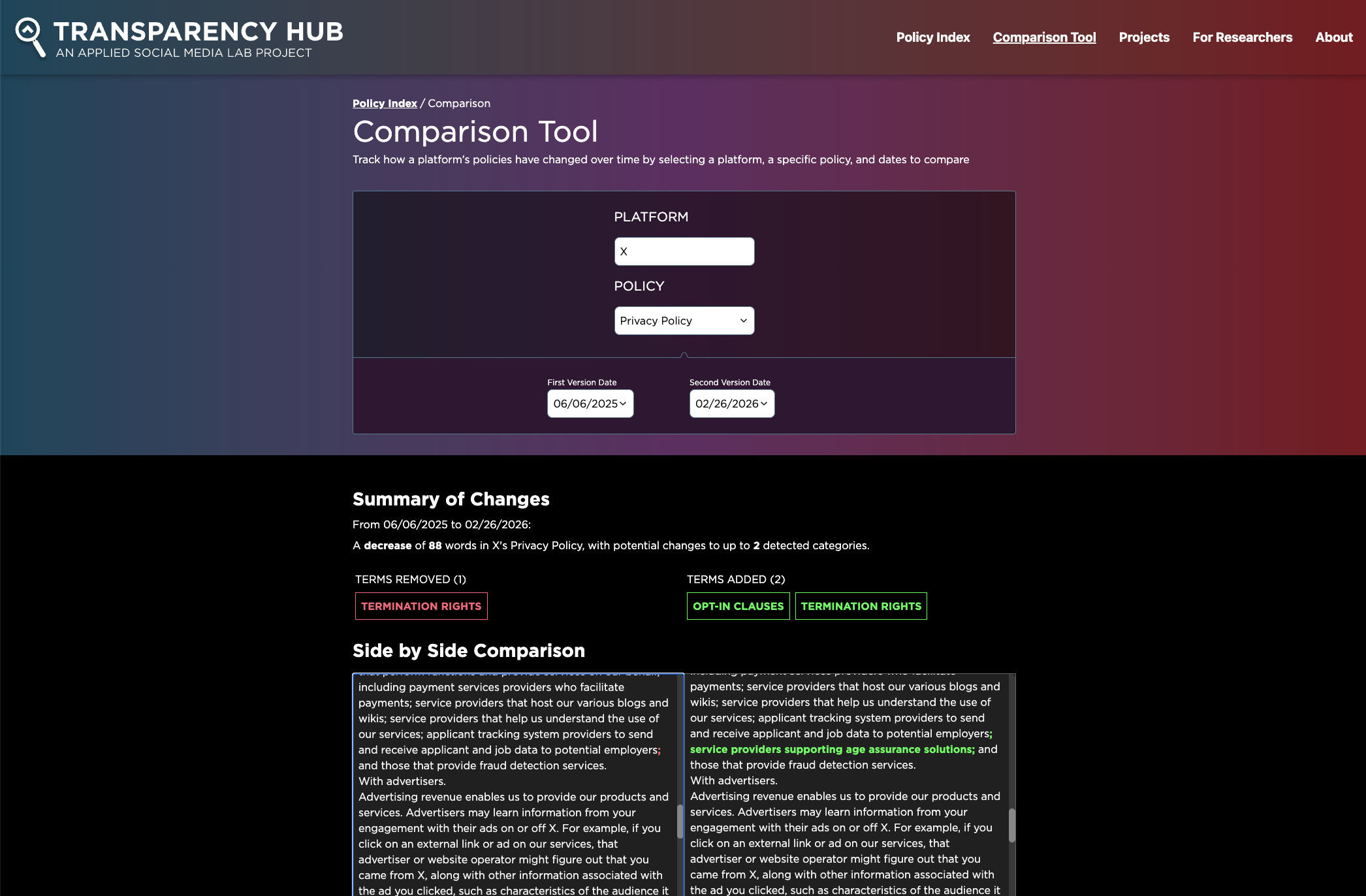
Tools for users: Transparency Hub provides several interfaces for querying our database. For example, users can browse documents by platform, exploring a platform’s current documents and comparing those to archived policies to understand how the policies have evolved. There’s also a helpful tool to compare documents across platforms. Using AI models, Transparency Hub also intends to offer automated document summarization and recommendations for how users can modify their platform settings to better safeguard personal data.
Who Can Benefit
We created this platform for
- Researchers, journalists, and analysts tracking changes in platform policies over time or across a variety of social media platforms
- Advocates, educators, and students studying or teaching digital rights and platform governance
- Developers and technologists building tools that require structured, accessible policy data
- Everyday consumers trying to understand platform rules, how they evolve, and how to better protect their personal data on these platforms
Get Involved
Help take back control of your data today! You can access Transparency Hub on GitHub here. Use this form to suggest platforms you would like Transparency Hub to track. You can also contact us here to report bugs or technical issues, or suggest new collaborations or feedback.
News
Transparency Hub Is Now Open Source
The public now has the source code to track policy changes across time.
Keep readingWHITE PAPER: Mapping the Burden: Toward Survivor-Centered Reporting Systems and Policies for Non-Consensual Intimate Images
Advances in generative AI have dramatically lowered the barriers to creating and distributing sexual “deepfakes” or non-consensual intimate images (NCII) — a form of technology-facilitated gender-based violence (TFGBV) that disproportionately…
Keep readingReading Between the Lines: How Platform Policies Construct Power
Note: The views expressed are those of the student author and do not necessarily reflect those of the Berkman Klein Center for Internet & Society or the Applied Social Media…
Keep readingTeam